
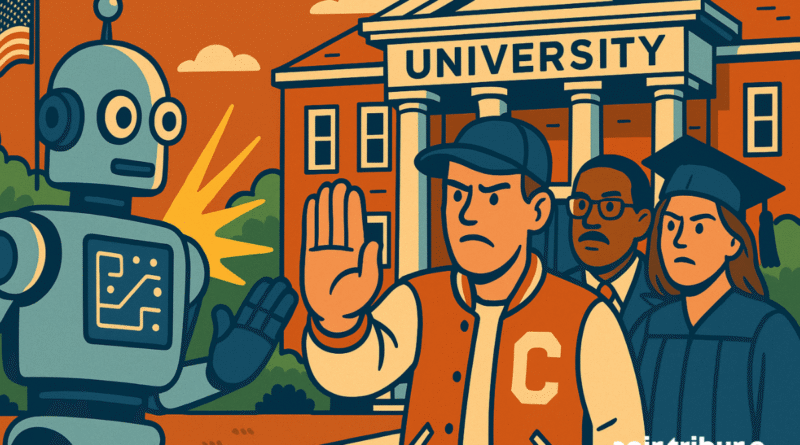
AI at the University: When America says “No Thank you”
While US universities are in large investment in artificial intelligence, from the University of Georgia to Michigan, a national survey reveals a surprising reality. American citizens, far from kissing this revolution, show growing distrust of AI integration on campuses.
In short
- More than half of Americans judge a negative AI for students’ learning.
- 46 % think that its use weakens academic support.
- Even generations, however familiar with AI, remain skeptical.
- 40 % believe that AI deprives university titles.
AI divides an opinion on American universities
Since 2023, US universities have multiplied initiatives around AI. The University of Georgia has prepared a journey of Microsoft Copilot generalized to the entire campus and a prize rewarding educational innovation in AI.
Michigan follows the creation of its own tools, while the state of Arizona has joined directly with Openai.
Despite these progress, however, public opinion remains cautious. According to a study of different grades of 2024, 53 % of Americans believe that the use of AI students damages their learning.
Only 27 % believe that this could have a positive effect, and almost fifth sees any significant impact. On the side of the teachers, observation is similar: 46 % of respondents believe that AI weakens the quality of support to students.
This skepticism is not surprising. Some teachers continue to sanction, sometimes incorrectly, work suspects that AI are generated.
Part of the students tend to rely too much on tools such as chatgpt or grammarly, which blurring the boundary between justified use and technological addiction.
Generation Z, more skeptical than expected
One might think that generations, born with smartphones and social networks, would spontaneously accept artificial intelligence. But the numbers tell a different story. In fact, only 19 % of 17-18 years believe that AI improves university learning, which is eight points less than the national average.
Even more pronounced, 54 % considers its use to the teacher negative, skepticism more pronounced than in their older ones.
Moreover, this caution reflects deeper concerns: the value of diplomas. It is true that 73 % of Americans still believe that higher education offers a good return on investment.
40 %, however, fears that AI depicts diplomas, especially because a number of “white passages”, financial analysts, consultants or assistants, could directly compete with algorithms.
Behind this statistics is the fundamental question: does the human dimension of education endanger? The recent study of Northwestern University in cooperation with the Hertie Institute for AI refers to health, strengthens these doubts.
In 2024, almost 13.5 % of biomedical publications have already carried traces of Chatgpt or similar tools, which increases doubts about transparency and academic integrity.
Artificial intelligence attracts as well as worries. On the American campuses, its establishment proceeds quickly, but trust is slowly following. The challenge is not limited to technology: it concerns culture, politics and very credibility of knowledge. Will the university education be able to transform AI into an educational ally, or will it remain a threat perceived for the academic future?
Maximize your Cointribne experience with our “Read to Earn” program! For each article you read, get points and approach exclusive rewards. Sign up now and start to accumulate benefits.

Passionate Bitcoin, I like to explore meanders blockchain and cryptos and share my discoveries with the community. My dream is to live in a world where privacy and financial freedom is guaranteed for everyone, and I firmly believe that Bitcoin is a tool that can make it possible.
Renunciation
The words and opinions expressed in this article are involved only by their author and should not be considered investment counseling. Do your own research before any investment decision.