
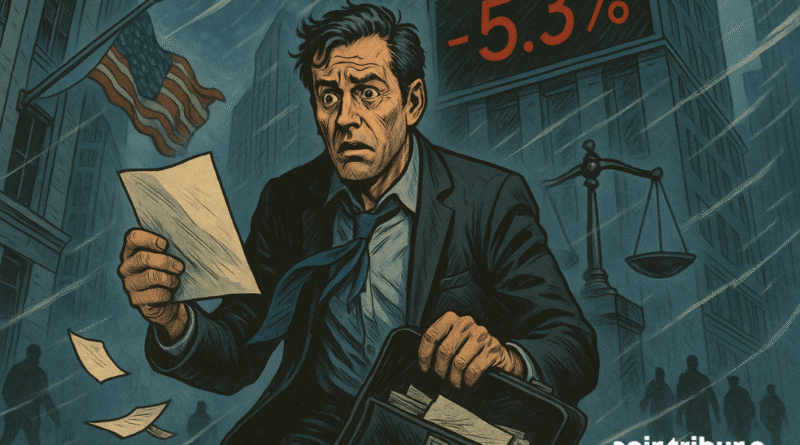
Seoul, Paris, Frankfurt … Markets collapsed after Washington’s announcement
The fragile balance of the world economy has just taken a new blow. 1er August Donald Trump signed an impressive regulation on severe customs duties in seventy countries, while the entry into 7 August was planned to enter on 7 August. This announcement immediately shaken the financial markets and strengthened tensions against the background of global instability. Behind this commercial offensive is an assertive protectionist strategy with potentially massive consequences for international trade, diplomatic relations and economic trajectories of the coming months.
In short
- Donald Trump signs a regulation depositing new duties on 70 countries, with the application scheduled for August 7.
- This announcement will start an immediate decline in the world’s main stock markets, especially in Paris, Frankfurt and Seoul.
- Markets forcibly respond to economic uncertainty, in the context of weakened unemployment in the United States.
- These new tariff measures emphasize imbalance in international trade and revive concerns about demonization.
Black day for scholarships
While the EU and the United States have joined the customs tariffs, signing a decree imposing a new customs duty by US President Donald Trump immediately shaken world markets. These taxes focused on 70 business partners up to 10 % to 41 % “Restructuring of world trade in favor of US employees”.
Although their entry into force was postponed to 7 August, their only formalization was sufficient to induce instability in main global financial centers. On the Wall Street Stock Exchange, the term contracts on three flag indices announced clear opening and translated the general interest in investors in the face of this protectionist orientation.
In Europe and Asia, the scholarships immediately responded down as soon as the meeting was opened on Friday morning. Here are the main variations observed at noon:
- Paris: -2.17 %;
- Frankfurt: -1.85 %;
- Milan: -1.86 %;
- London: -0.60 %;
- Seoul: -3,88 %;
- China and Japan: Mild drops.
Pharmaceutical values and large groups exposed to exports were among the most affected in the stock market. In the short term, this instability in the markets is produced by significant nervousness, nourished by the unpredictability of US decisions. Investors remain expectant, especially because several affected countries are still trying to negotiate exceptions before the maturity of 7 August.
Diplomacy under voltage
The reactions of targeted countries facing this unprecedented wave were fast. Several governments expressed their disagreement or required adjustments. China, involved in a commercial ceasefire with the United States running until August 12, condemned firmly and “Protectionism that damages all parties”.
Canada has been informed that its duties would increase from 25 % to 35 % of 1er August, with the exception of the products to which the Agreement on the North American Free Trade is covered. Sanction that, according to Donald Trump, stems from the Ottawa de intention “Recognize the state of Palestiny”The decision considered incompatible with American commercial interests. Brazil has seen its exports focused on 50 %, in response to legal proceedings against former President Jair Bolsonar, perceived as a strategic ally Washington.
In other regions, government is trying to save time or negotiate exceptions. Mexico thus gained a 90 -day stay before a possible increase in prices. In South Africa, the customs obligations of 30 % deposited by the United States would endanger up to 100,000 jobs according to the local central bank.
Its President Cyril Ramaphos spoke “Intense action” Alleviate the effects. Tai -wan, affected by 20 % despite the strategic importance of its semiconductor industry, said “Would try to obtain a reasonable level of customs duties”. On the other hand, Switzerland was hit by an unexpected surcharge of 39 %, far beyond the threshold of Prague, which applies to the European Union, causing the dismay of its government that continues “Find a negotiated solution”in spite of his “Great regret”.
In this climate, growing distrust of traditional assets will find certain values of refugees a central role. In particular, bitcoins see that its attraction will strengthen with investors looking for alternatives disconnected from national monetary policy. Krypto, often perceived as an active assistant during a period of turbulence, could benefit from a new wave of interest if geopolitical and economic tension deteriorates.
These measures are slightly more fragmented with international balance of trade in potentially sustainable consequences. In the short term, supplier chains can disrupt, increase diplomatic tensions and weaken economic alliance. They ask the question of permanent changes towards the medium -term orchestrated demonization.
In this context, some analysts have already evoke renewed interest in assets associated with decentralized funding, perceived as a refuge in the face of geopolitical and monetary instability. However, the negotiations window until 7 August could have allowed to partially alleviate the scope of these measures, provided the dialogue settles between the powers in question.
Maximize your Cointribne experience with our “Read to Earn” program! For each article you read, get points and approach exclusive rewards. Sign up now and start to accumulate benefits.
A graduate of the Toulouse and the Blockchain Consultant Certification certification certification I have joined Alyrou’s adventure in 2019. I convinced the potential of blockchain to transform many economy sectors, committing to raising awareness and informing the general public about how the ecosysty developed. My goal is to allow everyone to better understand blockchain and take the opportunity they offer. I try to provide an objective analysis of messages every day, decrypt trends on the market, hand over the latest technological innovations and introduce the economic and social issues of this revolution.
Renunciation
The words and opinions expressed in this article are involved only by their author and should not be considered investment counseling. Do your own research before any investment decision.